AI Virtual Cell: How GenBio AI Is Building a World Model of Human Biology
GenBio AI's AIDO Cell aims to simulate human cells from DNA and RNA to proteins and whole-cell behavior. Explore what virtual cells could mean for drug discovery and cancer research.
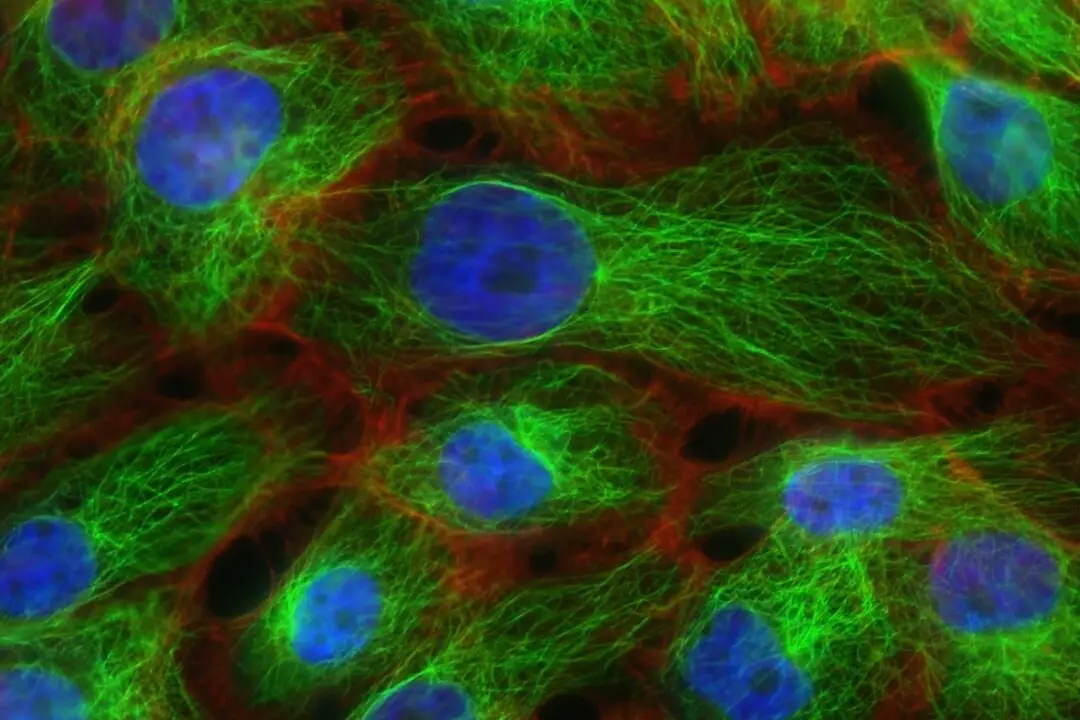
What if researchers could experiment on a digital version of a human cell before performing the same experiment in a laboratory?
That is the idea behind the emerging field of AI-powered virtual cells.
In August 2026, GenBio AI announced AIDO Cell, a virtual-cell world model designed to simulate human cellular behavior across multiple biological scales—from DNA and RNA to proteins and whole-cell activity. The company describes it as an early but functional preview of a system intended to help researchers computationally explore how cells respond to drugs, genetic changes and other biological interventions.
The development represents an important direction in AI for biology: moving from models that make individual biological predictions toward systems that attempt to simulate interconnected biological processes.
For medicine and oncology, this raises an important question:
Could AI-powered virtual cells eventually change how scientists study diseases and discover new treatments?
What Is an AI Virtual Cell?
An AI virtual cell is a computational model designed to represent and simulate aspects of how a biological cell behaves.
Instead of examining only one biological component, such as a gene or protein, a virtual-cell system aims to connect multiple layers of biology.
These layers can include:
DNA → RNA → proteins → molecular interactions → cellular processes → whole-cell behavior
The objective is to create a computational environment where researchers can introduce a biological intervention and observe the predicted consequences.
For example, a researcher might ask what could happen if:
- A gene is switched off
- A genetic pathway is altered
- A drug is introduced
- A molecular interaction changes
- A cellular process is disrupted
Rather than testing every possibility experimentally, a virtual cell could potentially help researchers prioritize which experiments are most informative.
What Is GenBio AI’s AIDO Cell?
GenBio AI describes AIDO Cell as a world model for the virtual cell.
According to the company’s August 18 announcement, the system is designed to simulate a human cell in its natural state as well as its response to drugs and other interventions across the biological hierarchy from DNA and RNA through proteins to the whole-cell level.
The system is based on the broader AI-Driven Digital Organism (AIDO) vision developed by GenBio AI.
The company’s stated objective is to create a unified model of biology capable of connecting information across biological scales and eventually simulating living systems.
AIDO Cell is therefore better understood as an early step toward a much larger computational model of biology rather than a complete digital replacement for a laboratory cell.
Why Is a “World Model” Important?
The term world model comes from AI research.
A conventional predictive model may answer a specific question:
What is the likely outcome of this particular biological perturbation?
A world model aims to go further by representing a dynamic environment in which actions can produce changing states.
GenBio AI’s research describes a virtual-cell world model as a generative system capable of simulating biological possibilities following interventions. Its proposed architecture is intended to support action-conditioned simulation, counterfactual reasoning and longer sequences of biological changes.
This distinction is important.
A virtual cell is not simply a database of biological facts.
The larger vision is to create a computational laboratory for exploring biological possibilities.
A Virtual Cell Can Remember Previous Interventions
One of the notable features highlighted by GenBio AI is that AIDO Cell is designed to be stateful.
That means the simulation can retain the effects of previous interventions.
Imagine a sequence such as:
Drug A → cellular response → Drug B → additional response → genetic perturbation → new cellular state
In a stateful virtual environment, each intervention can build on the previous state rather than treating every experiment as an isolated prediction.
GenBio AI says this is one of the characteristics that differentiates its world-model approach from more narrowly focused biological prediction systems.
How Could AI Virtual Cells Change Drug Discovery?
Drug discovery is a long and expensive process partly because human biology is extremely complex.
A drug does not interact with a single isolated target. Its effects can propagate through molecular pathways, cellular systems and tissues.
A virtual-cell model could potentially help researchers investigate those interactions earlier in the discovery process.
1. Exploring Drug Mechanisms
Researchers could use virtual-cell simulations to investigate how a candidate drug might affect cellular processes.
2. Prioritizing Experiments
Instead of testing every possible combination experimentally, computational simulations could help identify the experiments most likely to generate useful information.
3. Investigating Drug Resistance
Cancer and other diseases can evolve mechanisms that reduce treatment effectiveness.
Virtual-cell models could potentially help researchers explore how cellular states change following treatment and investigate possible resistance mechanisms.
4. Studying Toxicity
A drug may affect healthy cellular processes as well as disease-associated targets.
More comprehensive cellular simulation could eventually help researchers investigate potential unwanted effects earlier in development.
These are potential applications—not established clinical capabilities. A virtual cell still needs extensive experimental validation before its predictions can be relied upon for medical decisions.
Why This Matters for Cancer Research
The implications for oncology are particularly interesting.
Cancer is not a single biological process. Tumors involve genetic alterations, signaling pathways, cellular interactions, immune responses and changes in the surrounding tissue environment.
A model capable of representing cellular behavior across multiple biological levels could provide researchers with another way to investigate this complexity.
Understanding Cancer Biology
Researchers could potentially use virtual-cell systems to explore how particular genetic alterations influence cellular behavior.
Studying Targeted Therapies
Cancer therapies often target specific molecular pathways.
A virtual-cell environment could help researchers investigate how changes in one pathway might influence other cellular processes.
Exploring Treatment Resistance
Cancer cells can adapt under treatment pressure.
Computational simulations may eventually help researchers explore possible biological routes to resistance and identify hypotheses for laboratory testing.
Investigating Combination Therapies
Cancer treatment frequently involves combinations of therapies.
Testing every possible combination experimentally can be extremely challenging.
A sufficiently accurate virtual-cell model could eventually help researchers narrow the search space before conducting laboratory experiments.
A Real Example: Imatinib and Leukemia Cells
GenBio AI reported an early case study in which AIDO Cell was used to recapitulate the mechanism behind imatinib in leukemia cells.
The significance of this example is not that the system has solved leukemia research.
Rather, it demonstrates the type of question researchers hope virtual cells will eventually answer:
How does an intervention propagate through a complex cellular system?
If such simulations become sufficiently accurate, they could become useful tools for generating and testing hypotheses about disease mechanisms and therapeutic responses.
What Cell Types Does AIDO Cell Support?
The August 2026 announcement states that the preview version of AIDO Cell supports the K562 and HepG2 cell lines, with additional cell types in development.
The company also said it is preparing an early-access and academic collaborator program involving researchers from academia, biotechnology and pharmaceutical organizations.
This highlights an important point: the technology is currently an early-stage research platform, not a universal simulator of every human cell.
From AI Models to AI-Driven Biology
The emergence of virtual-cell world models reflects a broader change in scientific AI.
Early AI applications in biology often focused on individual tasks:
- Predicting protein structures
- Analyzing DNA sequences
- Predicting gene expression
- Classifying medical images
- Identifying potential drug candidates
The next phase may involve connecting these capabilities.
A broader computational biology architecture could combine information about:
Genes + RNA + proteins + cellular structures + molecular interactions + cellular states
This is one reason the concept of a biological world model is attracting attention.
GenBio AI’s broader research program includes models for DNA, tissue and other biological domains, with the goal of integrating biological information across scales.
AI + Virtual Cells + Autonomous Research
Another interesting development is the use of agentic AI to build and improve virtual-cell systems.
GenBio AI has described VCHarness, an AI system that can propose models, write code, conduct computational experiments, analyze results and iterate. In reported CRISPR perturbation benchmarks, the system discovered models that outperformed expert-designed baselines while reducing development time from months to days.
The company has also announced collaboration with NVIDIA around agentic AI and virtual-cell development.
This suggests a potentially powerful future workflow:
AI designs model → AI runs simulation → AI analyzes results → AI improves model → scientist validates experimentally
The human researcher remains critical, particularly for experimental design, interpretation, validation and safety.
What Are the Limitations?
It is important not to confuse an ambitious virtual-cell model with a perfect digital replica of human biology.
Living cells are extraordinarily complex.
A model can only be as reliable as its underlying data, architecture, assumptions and validation.
Important challenges include:
- Limited biological datasets
- Differences between cell lines and human tissues
- Incomplete understanding of biological mechanisms
- Model uncertainty
- Generalization across cell types
- Difficulty representing the full complexity of tissues and organisms
- Experimental validation
- Reproducibility
- Potential bias in training data
GenBio AI itself characterizes AIDO Cell as an early preview and states that more advanced versions with improved capabilities and accuracy are planned.
Therefore, virtual-cell predictions should currently be viewed as research hypotheses and computational predictions, not substitutes for laboratory or clinical evidence.
Could Virtual Cells Replace Laboratory Experiments?
Probably not.
A more realistic future is AI-augmented experimental science.
Instead of replacing the wet lab, virtual cells could help researchers decide:
Which experiment should we perform next?
This could reduce unnecessary experimentation and make research workflows more efficient.
The relationship could look like:
Computational hypothesis → Virtual-cell simulation → Experiment → Experimental data → Model update → New hypothesis
This creates a continuous feedback loop between computational and experimental biology.
The Future of Digital Biology
The long-term vision behind technologies such as AIDO Cell is much larger than simulating one cell.
GenBio AI describes its broader objective as an AI-Driven Digital Organism, with a goal of modeling biological systems across scales.
If this vision becomes technically achievable, researchers could eventually move from simulating individual biological components toward computational representations of increasingly complex systems.
That could transform how scientists approach:
- Drug discovery
- Disease mechanisms
- Cancer biology
- Toxicology
- Precision medicine
- Therapeutic development
- Biological engineering
But the path from an early virtual-cell model to a reliable digital representation of human biology is likely to require substantial advances in AI, experimental biology, data quality and scientific validation.
What Does This Mean for the Future of Oncology?
For oncology, the most important possibility may not be a “digital tumor” appearing overnight.
Instead, virtual-cell technology could gradually become another layer of computational intelligence within cancer research.
Researchers may eventually be able to combine:
Patient data + tumor genomics + molecular biology + AI models + virtual-cell simulations
to generate more detailed hypotheses about how an individual cancer might behave.
Such approaches could contribute to the longer-term development of more personalized treatment strategies.
However, clinical applications require rigorous validation and regulatory evaluation. Virtual-cell predictions should not currently be interpreted as personalized treatment recommendations.
Key Takeaways
- AIDO Cell is GenBio AI’s early virtual-cell world model.
- The system is designed to simulate cellular biology across multiple scales, from DNA and RNA to proteins and whole-cell behavior.
- Its world-model architecture is intended to support dynamic, stateful simulation rather than isolated predictions.
- Virtual cells could potentially accelerate drug discovery and biological research.
- Cancer research is a particularly promising potential application because of the complexity of tumor biology.
- GenBio AI has reported an early AIDO Cell case study involving imatinib and leukemia cells.
- The technology remains an early-stage research platform and requires extensive validation.
- The future may involve AI systems working alongside laboratories rather than replacing experimental science.
Frequently Asked Questions
What is an AI virtual cell?
An AI virtual cell is a computational model designed to simulate aspects of cellular biology and predict how a cell may respond to genetic, chemical or environmental interventions.
What is AIDO Cell?
AIDO Cell is a virtual-cell world model introduced by GenBio AI in August 2026. The company says it can simulate human cellular behavior across a hierarchy extending from DNA and RNA through proteins to whole-cell behavior.
Can virtual cells be used for cancer research?
Potentially. Virtual-cell technology could help researchers investigate cancer mechanisms, drug responses, genetic perturbations and treatment resistance. However, these applications remain an active area of research and require experimental validation.
Can an AI virtual cell replace laboratory experiments?
No. Current virtual-cell systems are research tools. Their predictions need to be tested against experimental evidence.
How could virtual cells improve drug discovery?
They could potentially help researchers explore biological mechanisms computationally, prioritize experiments, investigate drug responses and reduce the number of hypotheses that must initially be tested in the laboratory.
What is a biological world model?
A biological world model is an AI system designed to represent and simulate possible states and transitions within a biological system. In the virtual-cell context, this means modeling how cellular states can change following interventions.
Conclusion
The development of AI-powered virtual cells marks an important evolution in computational biology.
GenBio AI’s AIDO Cell represents an early attempt to move beyond isolated biological predictions toward a dynamic, multi-scale model of cellular behavior.
The technology is still developing, and claims about its future impact should be viewed carefully. But the direction is significant.
If virtual-cell models become increasingly accurate and experimentally validated, they could provide scientists with a new kind of research environment—one where biological hypotheses can be explored computationally before being tested in the laboratory.
For oncology, this could eventually mean faster exploration of cancer biology, therapeutic mechanisms and treatment strategies.
The larger vision is compelling:
Instead of asking AI only to predict biology, researchers are beginning to ask whether AI can simulate biology.
That distinction could shape the next generation of AI-driven drug discovery and cancer research.
Source & Further Reading
This article is an original educational analysis based on GenBio AI’s public announcement and research materials. Readers interested in the underlying technology should consult the original GenBio AI publications and technical materials for the latest information.
Educational content only. This material is written for healthcare professionals and students. It is not medical advice, and it must not be used for diagnosis or treatment decisions. Clinical decisions remain the responsibility of a qualified healthcare professional. Full disclaimer
Related resources

Merck and Moderna announced positive topline results from the Phase 3 INTerpath-001 trial for an individualized mRNA-based cancer therapy in melanoma.
Discover how AI-powered clinical trial matching can help breast cancer patients and oncologists identify potentially relevant clinical trials faster—and understand its benefits and limitations.
A new AI model analyzes routine H&E pathology slides to predict TP53 mutations, RNA expression, tumor type and survival outcomes across 32 cancer types.